
Royal Memorials did not begin with a business plan. It began with a family loss, a question that stayed with me, and a growing feeling that remembrance could be more personal than the traditions I had grown up around.
One day in May, my partner's grandmother passed away. She had raised my partner from childhood and had spent much of her life caring for others as a rural medical worker. What made that day particularly difficult for our family was that it was also my child's birthday. We were celebrating the beginning of a new year in one life while saying goodbye to someone whose life had shaped another.
I have thought about that coincidence many times since. I still do not know why those two moments happened on the same day, but I know that the experience changed the way I thought about life, family, loss, and what we leave behind.
A Decision Made Out of Love
In China, traditional thinking around death has long placed importance on burial and the idea of returning to the earth. Cremation, however, has become increasingly common, supported in many places by public policies and funeral benefits. My partner's grandmother chose cremation. She had been a rural medical worker during her lifetime, and her decision was practical in some ways: In her case, choosing cremation also meant that the family could receive funeral assistance that was not available to them under a traditional burial arrangement.
But I did not see her decision as simply practical. She was thinking about the people she would leave behind and choosing, in her own way, to make things a little easier for them. Even at the end of her life, she was still thinking about the family she loved. That stayed with me, and it made me ask a question that would eventually become part of the foundation of Royal Memorials: what do we, the people who remain, do with that love?
What Does It Mean to Remember Someone?
I grew up in China in the 1980s, without my mother, so my understanding of family was never based entirely on the traditional picture of a complete household. Perhaps because of that, I have always been conscious of the people who quietly shape our lives and of how deeply their absence can be felt when they are gone.
My partner's grandmother was one of those people. She had been there throughout my partner's childhood and had remained an important part of our family for many years. When she died, I began to look at remembrance differently.
Traditional ceremonies have their place. Graves, memorial halls, photographs, offerings, and anniversaries can all provide meaningful ways for families to remember. But I began wondering whether there could also be more personal ways to keep a connection alive. Could remembrance become something we carry with us? Could a photograph become something tangible? Could a name, a date, a small portion of ashes, or a personal object become part of everyday life?
I also wondered whether there could be a place where someone's stories and memories could continue to exist beyond a funeral or a cemetery. Those questions eventually led me in two directions. One became CQSS.org, a project built around digital memorialization. The other became Royal Memorials.
The First Step Was Not a Product
CQSS was my first attempt to answer those questions in a digital form. I wanted remembrance to have a place where a person's name, photographs, stories, and memories could remain, not only for the day of a funeral but for the years that follow.
That experience taught me something simple: remembrance does not have to be confined to one place or one ceremony. But I also began to see another side of it. Sometimes people want something they can hold, something that can remain in their home, something they can touch, and something personal enough to belong to one family rather than simply being another product.
That was where my thinking began to move toward physical memorial objects.
I Did Not Come From the Funeral Industry
I did not come from the funeral industry. I did not inherit a funeral business, nor did I begin this journey as an industry expert. I began as someone who had experienced loss and wanted to understand what meaningful remembrance could look like. What I lacked in industry experience, I tried to make up for through years of research, travel, conversations, and hands-on exploration of materials, craftsmanship, design, and the memorial industry.
The idea did not become a company overnight. I spent years trying to understand how different cultures approach remembrance and, just as importantly, what happens behind the finished product. I wanted to know how memorial objects were made, why particular materials were chosen, what could be improved, and what a memorial object should feel like in the hands of a family.
That process eventually became the foundation of how we approach product development at Royal Memorials.
Looking for Materials, Craftsmanship and Better Ideas
As the idea developed, I began traveling to places where the materials and crafts themselves had deep histories. In Shuitou, Fujian, one of China's major natural stone centers, I explored natural stone and new processing techniques. In India, I looked at metal urn manufacturing and ways traditional construction could be improved. In Jingdezhen, I spent time learning about the craftsmanship and design traditions behind China's historic imperial porcelain.
In Beijing, I explored the traditions behind Cloisonne enamel, a craft with deep roots in China's imperial history. What interested me was not simply reproducing a traditional decorative object, but understanding how that heritage could be adapted to a memorial purpose. The challenge was to preserve the discipline and character of the craft while creating something that could belong naturally in a modern family's home.
Each place taught me something different. More importantly, these experiences changed how I looked at a finished memorial product. A memorial object is not simply a shape, a material, or a price. The material affects how it ages, the construction affects how it performs, the surface affects how it feels in a home, and the proportions affect how it is perceived. When the object is connected to someone a family loves, details that might seem small in another product become much more important.
Learning From the International Deathcare Community
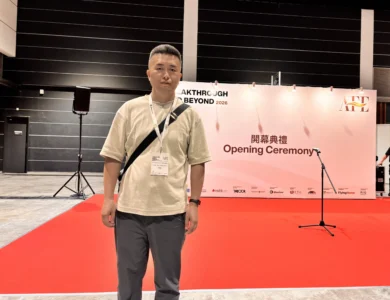
The exploration was not limited to manufacturing. I also wanted to understand how the memorial industry was changing beyond China, particularly in the United States and other international markets. In Hong Kong and through international industry events, I began speaking with people working across the funeral and memorial profession. These conversations helped me see the differences between markets, but also the things they have in common.
Families may have different traditions, languages, and customs, but the need to remember someone they love is universal.
In May 2026, I attended the Asia Funeral and Cemetery Expo & Conference in Hong Kong. There, I had the opportunity to meet Christine Pepper, Chief Executive Officer of the National Funeral Directors Association (NFDA), face to face and discuss Royal Memorials' development, ideas, and direction with her.
That conversation mattered to me not because I was looking for an endorsement. I was looking for perspective. The more I learned from people already working in the industry, the more convinced I became that memorial products should not be designed around manufacturing alone. They need to consider the person choosing the object, the family receiving it, and the role it may play years after the funeral is over.
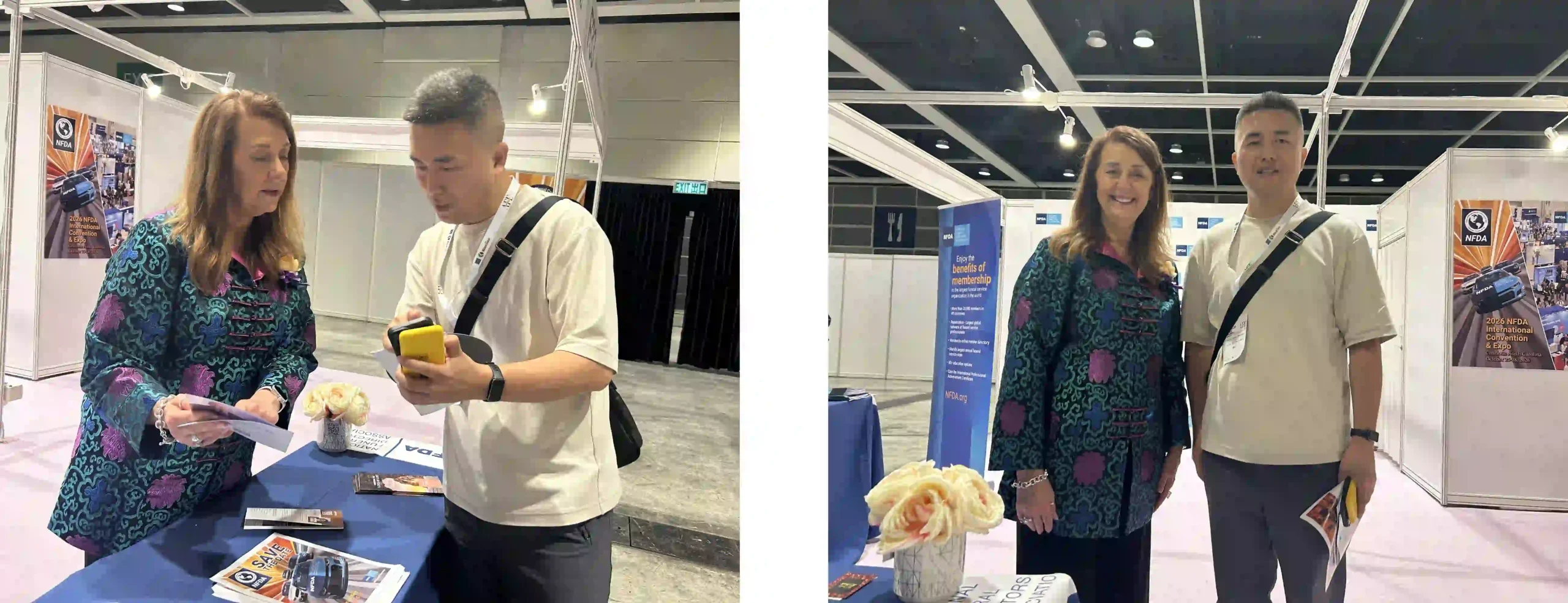
James Wei speaking with Christine Pepper, NFDA Chief Executive Officer, at the 2026 Asia Funeral and Cemetery Expo in Hong Kong.
A Journey Beyond Manufacturing
Not every part of this journey took place in workshops or industry events. I also spent time in Lhasa, Tibet, one of the highest places in the world. Being there gave me the distance to step away from the practical questions of materials and manufacturing and think again about the reason behind all of it: why certain objects become meaningful after someone we love is gone.
The search was never only about materials or manufacturing. It was also about understanding why certain objects become meaningful to people and how design can respect that meaning without becoming excessive or theatrical.
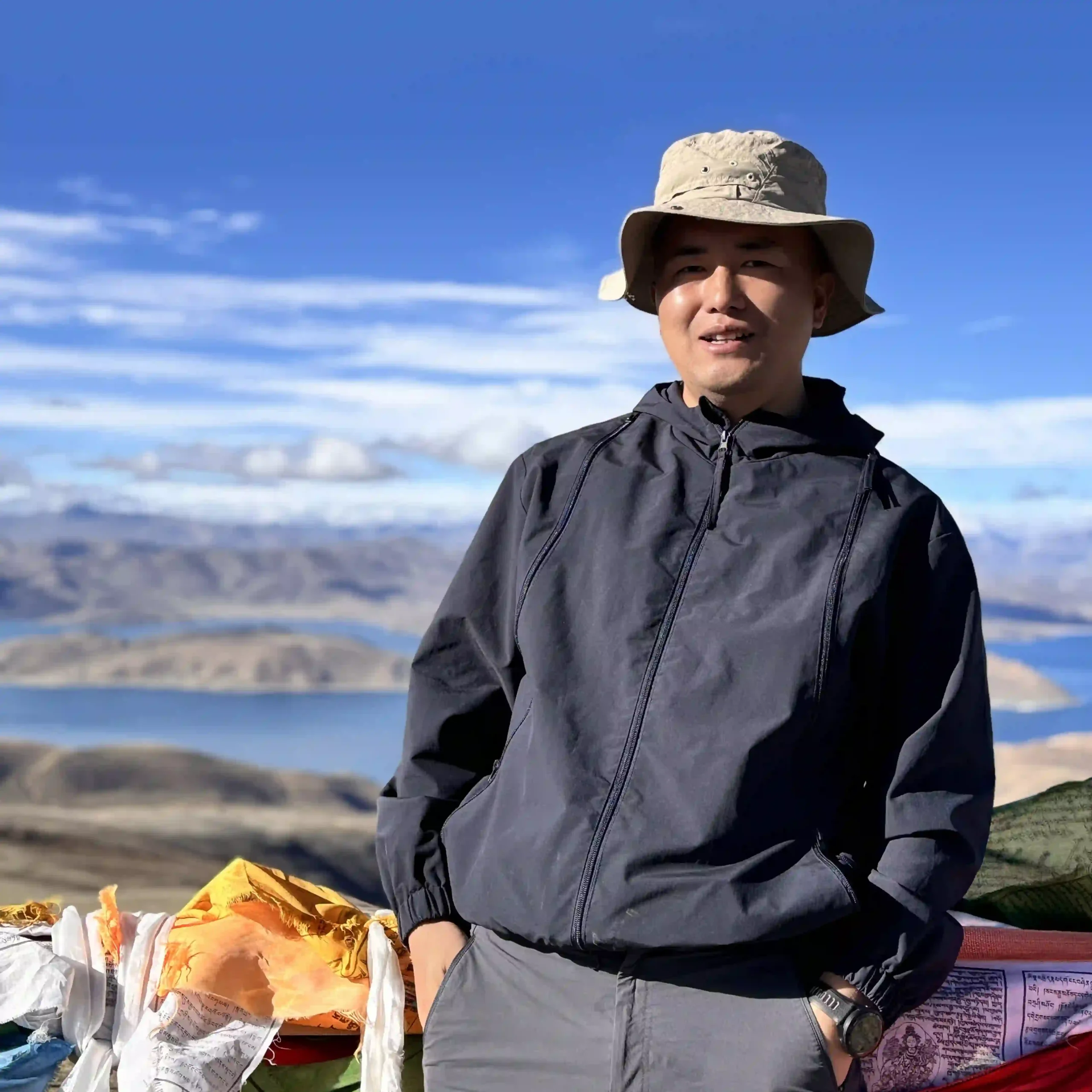
James Wei, Founder of Royal Memorials, in Lhasa, Tibet.
Why Royal Memorials?
The name Royal Memorials came from a simple idea: remembrance should be treated with dignity. “Royal” was never meant to suggest that memorials need to be extravagant. To me, it represents a standard of care—the idea that the memory of an ordinary person deserves the same respect and attention to detail as anyone else's.
That principle became part of how we approached the brand. I wanted design and manufacturing to work together rather than exist as separate parts of the process. I wanted materials to be chosen for more than appearance, personalization to feel accessible rather than treated as an expensive extra, and the experience of receiving a memorial product to feel considered because this is not an ordinary purchase.
Building Royal Memorials
As the idea developed, the work became more structured. Our approach began to take shape around material selection, craftsmanship, product development, and inspection. Our White Glove Inspection™ reflects a simple belief: a memorial product deserves to be examined with care before it reaches a family.
Our Ceremony Care Kit™ grew from the same idea. The experience surrounding a memorial matters, not only the object itself. Complimentary engraving also became part of our approach because a name, date, or few personal words can turn an object into something belonging to one family rather than simply being another product.
These details may seem small when viewed separately, but together they represent the kind of memorial experience I wanted to build.
From China to Families Around the World
I was born and raised in China, and much of the manufacturing and craft knowledge behind Royal Memorials is rooted there. I do not see that as separate from our international direction. China has a deep manufacturing ecosystem and centuries of craftsmanship across many materials. The challenge is not simply having access to that capability. The challenge is knowing how to select it, control it, improve it, and translate it into products that make sense for families in different parts of the world.
Royal Memorials was built with that international perspective. Our customers may live in the United States, Canada, Australia, Japan, or elsewhere. Their cultures and traditions may differ, but the underlying experience is familiar: someone they love is gone, they want to remember that person, and they want something that feels worthy of that memory.
Why Memorial Jewelry Became Part of the Story
This is also why cremation jewelry became an important part of Royal Memorials. A traditional urn gives ashes a dedicated place, while a memorial necklace can allow a small portion to remain physically close. Neither is more meaningful than the other. They simply serve different forms of remembrance.
The same idea applies to keepsakes, personalized memorials, and digital memorial spaces. There is no single correct way to remember someone. The right memorial is the one that feels meaningful to the person and family choosing it.
May 13, 2026
Royal Memorials officially launched on May 13, 2026. For me, that date represents the point at which an idea that began with a family loss became something that could be shared with families beyond my own.
The launch did not mean the journey was finished. In many ways, it was only the beginning. We are continuing to develop new memorial products, explore materials and craftsmanship, improve how we inspect and present our products, and build a service experience for families beyond our original market.
What I Hope Royal Memorials Becomes
I do not know every family who will eventually choose something from Royal Memorials, and I do not pretend that one company can define the right way to remember someone. Every family has its own traditions, memories, and ways of saying goodbye. What I do know is what it feels like to stand between celebration and loss, to think about someone who is no longer there, and to wonder how a relationship continues after death.
Every year, when my child's birthday comes around, I remember that day in May 2021. I remember that we were celebrating a new life while saying goodbye to someone who had spent her own life caring for others. I still do not know why those two moments happened on the same day, and I no longer feel the need to find an answer. What matters to me is what the experience taught me: life continues, love continues, and sometimes the objects, stories, and rituals we choose help carry that love forward.
That is why I started Royal Memorials. It is not simply a store for cremation urns, memorial jewelry, or keepsakes. It is an attempt to create better ways for families to hold on to what matters, with greater care in the materials, design, craftsmanship, and experience surrounding each memorial.
— James Wei
Founder, Royal Memorials
If you are choosing a memorial for someone you love and are not sure where to begin, our team is here to help you explore the options with care.
Why I Started Royal Memorials
Royal Memorials did not begin with a business plan. It began with a family loss, a question that stayed with
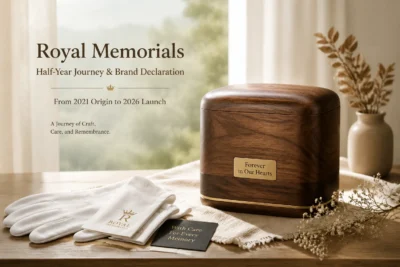
Royal Memorials Half-Year Journey & Brand Declaration
(From 2021 Origin to 2026 Launch) Introduction: A Beginning That Started in 2021 The story of Royal Memorials did not